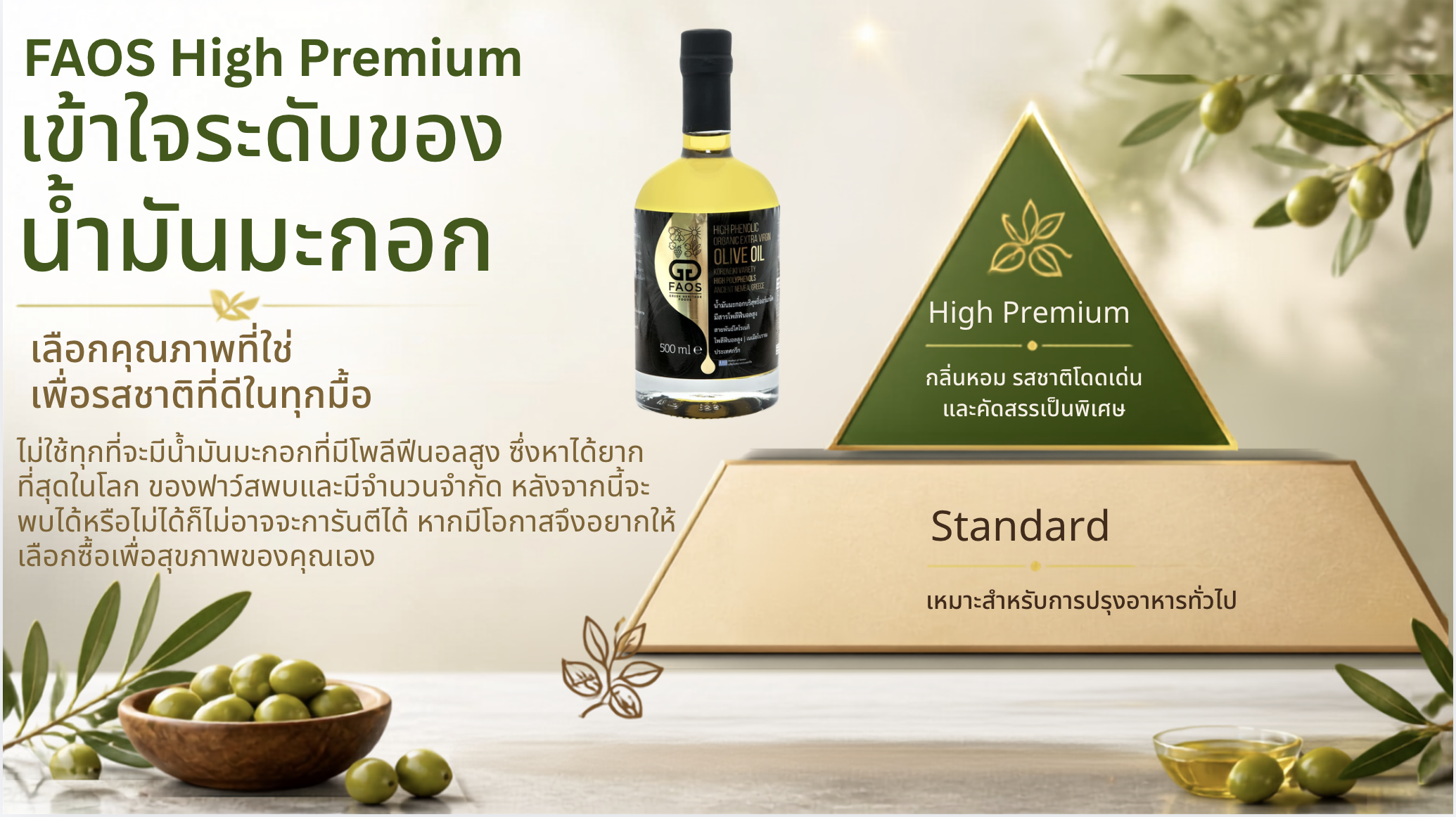
The difference between premium olive oil and standard olive oil
FAOS High Premium – Premium extra virgin olive oil from Greece with the highest polyphenol content in the world 🌿✨ Not everywhere offers olive oil with high polyphenol content and this rarest quality in the world. At FAOS, we curate our selection meticulously with limited quantities, and we cannot guarantee if or when it will be available again in the future. Choose the right quality for the best flavor in every meal and for your own good health: High Premium: Distinctive aroma, exceptional taste, and specially selected. Rich in high antioxidants (Polyphenols). Standard: Suitable for general everyday cooking. Key Differences High Polyphenol Olive Oil (High Premium): An extra virgin olive oil (EVOO) specially selected from indigenous olive varieties and favorable growing regions. It contains an exceptionally high amount of "polyphenols," which are natural antioxidants found in fresh olives, featuring a distinct aroma and unique taste (may have a slight peppery kick or bitterness at the back of the throat when consumed, which is a good sign of authentic polyphenols). It is classified as a rare, premium grade with limited availability. Standard Olive Oil: Focused on general everyday use, such as standard cooking processed according to typical olive oil grades, but containing normal, typical levels of natural polyphenols and deep nutrients. Health Benefits of the "High Polyphenol" Grade Polyphenols in olive oil act as a premier health shield, backed by research providing prominent benefits such as: Anti-inflammatory and Antioxidant: Helps reduce chronic inflammation in the body, which is the root cause of various degenerative diseases. Heart and Cardiovascular Support: Helps control lipid levels, prevents cholesterol oxidation, and supports healthy blood vessel function. Blood Sugar Management: Contributes to insulin function and maintains blood sugar balance. Nervous System and Brain Protection: Antioxidants help slow down the degeneration of brain cells. Give your body this precious gift from nature to nurture your health from within. If you are interested in purchasing or learning more details, feel free to inbox us! #FAOS #FAOSOliveOil #HighPremiumOliveOil #GreekOliveOil #PremiumOliveOil #HighPolyphenols #HealthyFood #HealthyLiving
FAOS High Premium – Premium extra virgin olive oil from Greece with the highest polyphenol content in the world 🌿✨ The figure "high polyphenols up to 800" in FAOS olive oil refers to the concentration of total polyphenols, generally measured in milligrams per kilogram (mg/kg). The deeper meaning and benefits of this figure are as follows:
- EU Health Claim Certification (EU Regulation 432/2012): The European Union specifies that for olive oil to display a health claim on its label stating that "olive oil polyphenols contribute to the protection of blood lipids from oxidative stress," the olive oil must contain at least 250 mg/kg of polyphenols.
- High Quality and Rarity (High Polyphenol / Extra Virgin): Having a polyphenol content as high as 800 mg/kg is considered an extremely high premium grade (general olive oils on the market usually have low or moderate values). This is achieved through careful selection of olive varieties, harvesting at the optimal time (typically harvesting green olives before they are fully ripe), and a cold-pressed extraction process that preserves maximum nutrients.
- Physical Properties and Taste:
- Powerful Antioxidants: Polyphenols act as antioxidants, helping to reduce inflammation in the body and support heart health.
- Distinctive Taste: Olive oil with very high polyphenols has a peppery kick in the throat (pungency) and a slight bitterness, which serves as the "trademark" of high-quality, fresh extra virgin olive oil, rather than a defect.
The peppery sensation in the throat (pungency) and slight bitterness found in high-polyphenol olive oil indicate the exceptional natural quality of the oil, originating from key factors:
- The Antioxidant Oleocanthal: The peppery kick or mild throat irritation when swallowed comes from a phenolic compound called oleocanthal, which has anti-inflammatory properties similar to natural ibuprofen. The stronger the peppery sensation in the throat, the higher the content of this compound and polyphenols.
- Freshness and Production Process: Harvesting olives while they are still green (early harvest) and cold-pressing them quickly preserves these nutrients and original flavors fully, unlike fully ripened olives which have a milder or flatter taste but lower polyphenol levels.
Therefore, the peppery and bitter finish is not a flaw or a sign that the olive oil has gone bad, but rather a "trademark" of premium extra virgin olive oil with maximum health benefits. As a result, care should be taken to purchase from trusted producers to ensure the flavor and profile are authentic rather than artificially flavored or altered.
Major Findings & Studies
● EU Coordinated Action (2021–2022): An EU-wide testing campaign titled "From the Hives" sampled 320 honey consignments imported into Europe. The study, which involved laboratories and samples from Germany, found that 46% of samples were suspicious of adulteration with extraneous sugars.
● 2020 CSE Investigation: A high-profile study by India's Centre for Science and Environment (CSE) sent samples from top Indian brands to a specialized German laboratory for Nuclear Magnetic Resonance (NMR) testing. The German tests revealed that 77% of the samples were adulterated with sugar syrup, despite many having passed standard Indian laboratory tests.
● UK Supermarket Study: A 2020 investigation into UK supermarket honey utilized a leading German laboratory which found 8 out of 9 samples were non-compliant with authenticity standards.
https://pmc.ncbi.nlm.nih.gov/articles/PMC6513626/
https://pmc.ncbi.nlm.nih.gov/articles/PMC4216698/
https://pmc.ncbi.nlm.nih.gov/articles/PMC9719456/
https://pmc.ncbi.nlm.nih.gov/articles/PMC6893770/
https://pubmed.ncbi.nlm.nih.gov/31760826/
https://pmc.ncbi.nlm.nih.gov/articles/PMC7277934/
https://pubmed.ncbi.nlm.nih.gov/28527183/
https://pmc.ncbi.nlm.nih.gov/articles/PMC6225430/
https://pmc.ncbi.nlm.nih.gov/articles/PMC6115915/
https://pmc.ncbi.nlm.nih.gov/articles/PMC12071508/
https://pmc.ncbi.nlm.nih.gov/articles/PMC7022753/
https://www.spandidos-publications.com/10.3892/ijmm.2018.3656#tI-ijmm-42-02-0726
https://www.liebertpub.com/doi/10.1089/jmf.2012.0042
https://pmc.ncbi.nlm.nih.gov/articles/PMC9879079/
https://scijournals.onlinelibrary.wiley.com/doi/abs/10.1002/jsfa.11340
Patcharin Chanaphukdee
Sharing insights about premium Greek organic olive oil, natural honey, and the Mediterranean lifestyle to help you achieve optimal well-being.
Comments
Share your thoughts on this article